How to close a fiberglass pool in Quebec: complete guide
Closing a fiberglass pool is an important step before Quebec winters. The main goal is not simply to cover the pool, but above all to protect the plumbing, equipment and shell against freeze damage.
Closing a fiberglass pool is an important step before Quebec winters. The main goal is not simply to cover the pool, but above all to protect the plumbing, equipment and shell against freeze damage.
A proper closing also makes spring opening easier and reduces the risk of damage over winter.
In this guide, Piscine Riviera explains the key points for correctly preparing an inground fiberglass pool in Quebec.
Why close a pool in Quebec?
When water freezes, it expands.
In a fiberglass pool, freezing does not damage the shell itself. The risk comes mainly from water that can remain trapped in plumbing and equipment, including lines, the skimmer, returns, the pump, the filter, the heat pump, certain valves and salt systems.
When that water freezes, it expands and can crack or damage these components.
Winterization therefore mainly means removing that water before significant freeze periods.
When should you close a fiberglass pool?
There is no single universal date for every pool.
In the greater Montreal area, closing is generally done in the fall, once the swim season is over and the water temperature gradually drops.
It is still best to avoid two extremes.
Closing too early
A very early closing while the water is still warm can encourage algae growth.
Closing too late
Waiting for the first significant freeze periods can expose plumbing and equipment to temperatures low enough to cause damage.
Weather therefore matters more than the exact calendar date.
Should you empty a fiberglass pool for winter?
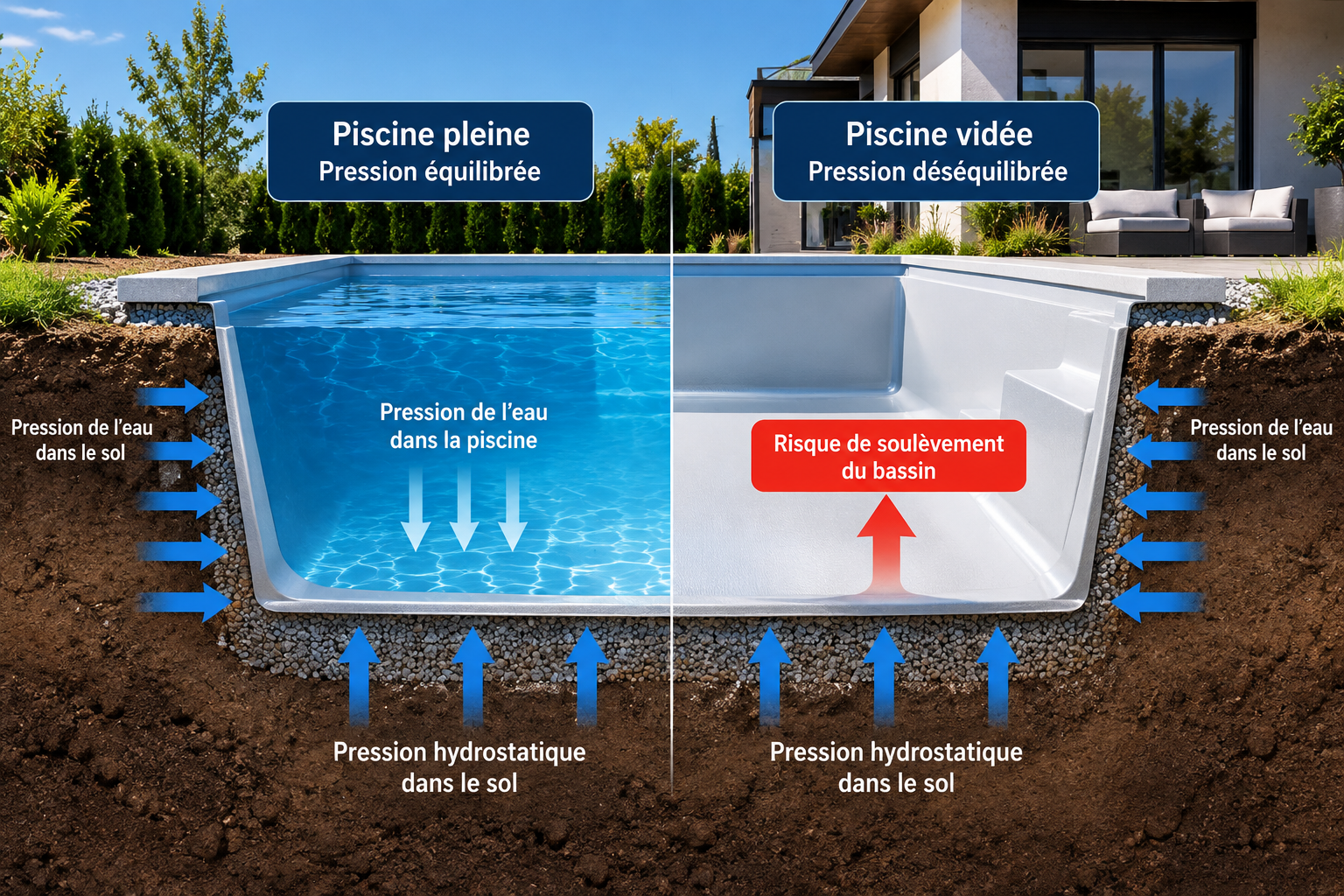
A fiberglass pool must never be fully emptied, even in winter. It must stay full to maintain the pressure needed for shell stability.
Water inside the pool helps counterbalance pressure from groundwater around the shell.
If a fiberglass pool is emptied while the groundwater level is high, hydrostatic pressure can push the shell upward and cause it to shift.
If a full drain becomes necessary, it should always be done with professional assistance.
It is strongly discouraged to empty a fiberglass pool yourself, because the water level around the shell must be controlled before and during the work.
Why is drainage around the shell important?
Because a fiberglass pool is installed directly in the ground, water around the shell must always be considered.
Heavy rain, snowmelt and a high water table can increase pressure around the pool.
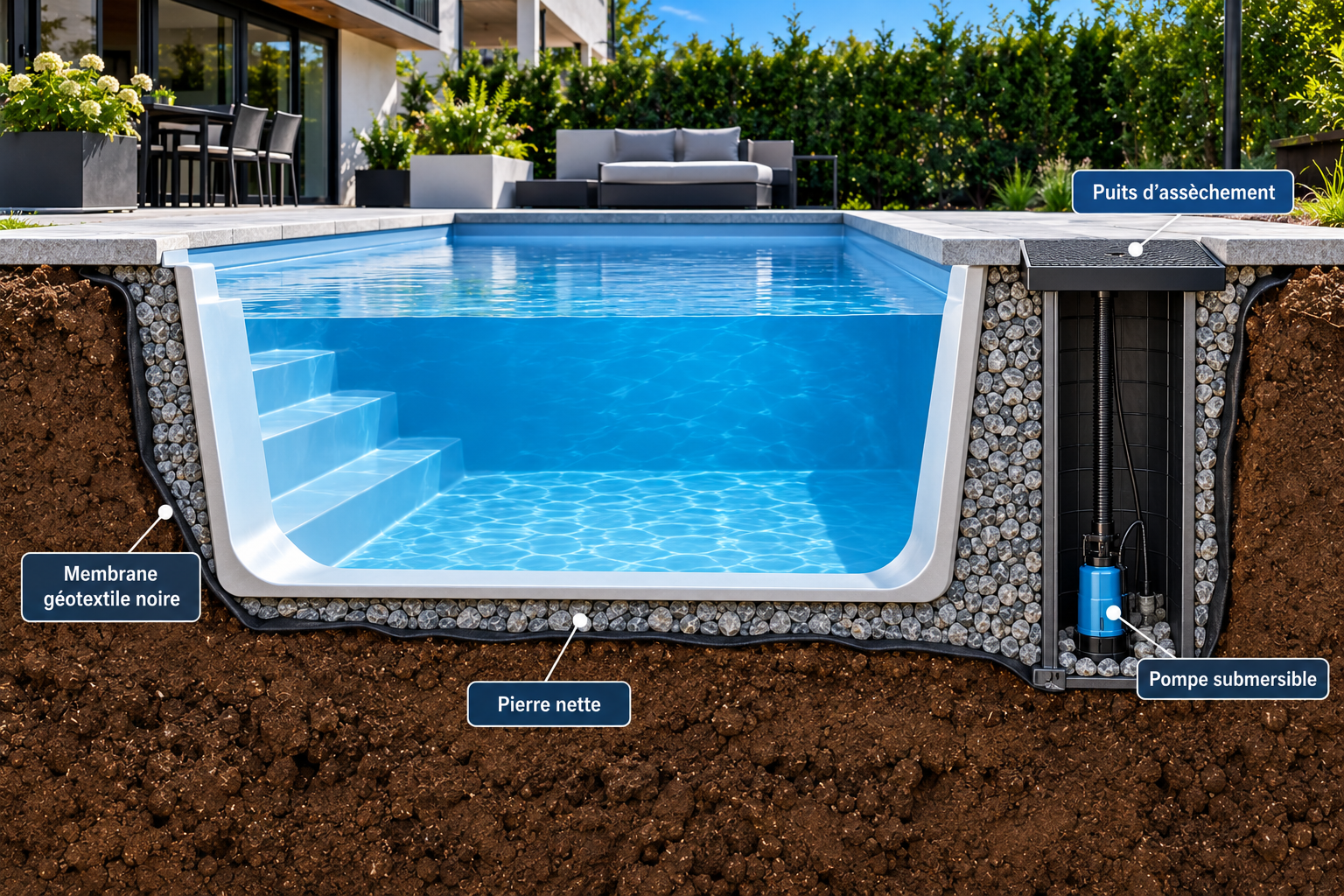
For a fiberglass pool, installing a dewatering well is mandatory.
This well lets you check the water level around the shell and, when needed, pump that water to reduce hydrostatic pressure.
The dewatering well is especially important before any work that lowers the pool water level.
It ensures the water level around the shell is controlled before water is removed from the pool.
Main steps to close a fiberglass pool
1. Clean the pool
Before closing, remove as many contaminants as possible: leaves, insects, debris and deposits on the floor.
It is also recommended to brush the walls and steps and clean the waterline.
The goal is to avoid leaving organic matter in the pool for several months, which can cause stains, deposits and a harder spring opening.
2. Check water balance
Before closing, also check water balance, including pH, alkalinity and sanitizer level.
Even if the pool will not be used in winter, well-balanced water helps protect water quality and pool components during the closed months.
3. Adjust the water level
For a fiberglass pool, you do not empty the shell. The pool must remain full.
Depending on skimmer layout and the closing method used, you may slightly lower the water level if needed to install winterization accessories.
The key idea is that you never remove a large amount of water from the shell simply to close the pool.
4. Close and protect the plumbing
Next, protect the lines against freezing.
Water must be blown out of the lines with a suitable blower, then the lines must be isolated with the proper winter plugs.
This may include:
- returns;
- the skimmer;
- certain equipment lines;
- the main drain, depending on pool configuration.
The goal is to prevent a pocket of water from remaining trapped in a line.
If that water freezes, it can expand and damage the plumbing.
For the main drain, the method is different because it sits underwater.
Air pressure is generally used to keep water from rising back into the line during winter.
5. Winterize the pump
A pool pump has several cavities where water can remain.
It must therefore be drained by removing the plugs provided for that purpose, following the manufacturer’s instructions.
The basket can be cleaned at the same time.
Even a small amount of water left in the pump can cause freeze damage.
6. Winterize the filter
The procedure varies by filter type.
For a cartridge filter, remove the cartridge, clean it and drain the housing.
For a sand filter, follow the manufacturer’s recommended steps and set the valves correctly.
In all cases, do not leave water that could freeze inside.
7. Winterize the heat pump
The heat pump must also be drained, because water circulates through its heat exchanger.
Simply cutting electrical power is not enough.
If water remains inside the heat pump and freezes, it can cause major equipment damage.
8. Winterize the salt system
If the pool has a salt system, the cell must also be protected for winter.
Depending on the model, the cell may be drained, inspected, cleaned or removed.
It is important to follow the manufacturer’s recommendations.
Should you install a winter cover?
A properly installed winter cover helps limit debris falling into the pool through fall and winter.
It can prevent large amounts of leaves, branches and other contaminants from collecting in the shell.
An appropriate cover can also greatly simplify spring opening.
What should you watch during winter?
Even when the pool is closed, it is useful to check its condition occasionally.
In particular, monitor:
- water level;
- cover condition;
- unusual water accumulation around the pool;
- drainage function and condition;
- the dewatering well.
Pay special attention after heavy rain or rapid snowmelt.
Common mistakes to avoid
Common mistakes when closing a fiberglass pool include:
- fully emptying the pool;
- waiting for freeze nights before closing;
- forgetting a line;
- not draining the heat pump;
- leaving water in the pump or other equipment;
- using antifreeze not designed for pool plumbing;
- neglecting drainage around the shell.
What is hydrostatic pressure?
Hydrostatic pressure is simply the pressure exerted by water.
With an inground pool, there can be water inside the shell and also in the soil around the shell.
As long as these forces stay balanced, the pool remains stable.
However, if too much water is removed from the pool while the surrounding soil holds a lot of water, exterior water pressure can push on the shell.
That is why a fiberglass pool is not emptied without control measures.
That is also why the dewatering well matters: it lets you check for water around the pool and pump it when needed.
In short, the pool must stay full and water around the shell must be properly managed.
The dewatering well and water management around the shell
For a fiberglass pool, installing a dewatering well is mandatory.
This well lets you check the water level around the shell and, when needed, pump that water to reduce hydrostatic pressure.
The dewatering well is especially important before any work that lowers the pool water level.
Does fiberglass handle Quebec winters well?
A well-installed fiberglass pool adapts very well to Quebec’s climate.
The shell is designed to stay in place through winter.
What mainly makes the difference in our climate is the quality of what surrounds the shell:
- backfill;
- drainage;
- plumbing;
- water management around the shell;
- proper winter preparation of equipment.
A good closing cannot fix a poor installation.
Conversely, a well-done installation makes closing and opening much more predictable year after year.
Can you close a fiberglass pool yourself?
In principle, you can close your own pool if you know its plumbing and equipment well.
However, for a first season, it is strongly recommended to call an expert to understand your pool’s specific layout.
Every pool can have different plumbing and equipment.
Having a professional handle the first closing helps the owner understand the steps for that installation before considering DIY closings later.
Piscine Riviera also offers pool closing service, performed by a team familiar with fiberglass pools and Quebec climate conditions.
In conclusion
To properly close a fiberglass pool in Quebec, the essentials are never fully emptying the shell, protecting plumbing and equipment from freeze, and monitoring water around the shell.
A well-done closing protects the installation through winter and makes spring opening much simpler.
To book a closing or ask about your installation, contact Piscine Riviera or request a quote.
Frequently asked questions
Peut-on vider une piscine en fibre de verre pour l’hiver?
Une piscine en fibre de verre ne doit jamais être vidée complètement, même pendant l’hiver. Elle doit rester pleine afin de maintenir la pression nécessaire à la stabilité du bassin. Si une vidange complète devient nécessaire, elle devrait toujours être effectuée avec l’assistance d’un professionnel.
Une piscine en fibre de verre doit-elle rester pleine pendant l’hiver?
Oui. Une piscine en fibre de verre doit demeurer pleine pendant l’hiver afin de maintenir un bon équilibre de pression autour du bassin. L’eau à l’intérieur aide à contrebalancer la pression exercée par l’eau présente dans le sol autour du bassin.
Pourquoi faut-il un puits d’assèchement avec une piscine en fibre de verre?
Pour une piscine en fibre de verre, l’installation d’un puits d’assèchement est obligatoire. Ce puits permet de vérifier le niveau d’eau présent autour du bassin et, au besoin, de pomper cette eau afin de réduire la pression hydrostatique. Il devient particulièrement important avant toute intervention où le niveau d’eau de la piscine doit être abaissé.
Comment protéger la plomberie d’une piscine contre le gel?
L’eau doit être évacuée des conduites à l’aide d’une soufflerie adaptée, puis les lignes doivent être isolées avec les bouchons d’hivernisation appropriés. Cela peut inclure les retours d’eau, l’écumoire, certaines lignes reliées aux équipements et le drain de fond, selon la configuration de la piscine. Le but est d’empêcher qu’une poche d’eau reste emprisonnée dans une conduite.
Comment fermer une thermopompe de piscine pour l’hiver?
La thermopompe doit être vidangée, car de l’eau circule dans son échangeur de chaleur. Couper simplement l’alimentation électrique n’est pas suffisant. Si de l’eau demeure à l’intérieur de la thermopompe et gèle, elle peut causer des dommages importants à l’équipement.
Peut-on fermer soi-même une piscine en fibre de verre?
En principe, il est possible de fermer sa piscine soi-même si on connaît bien sa plomberie et ses équipements. Cependant, pour une première saison, il est fortement recommandé de faire appel à un expert afin de bien comprendre la configuration spécifique de sa piscine. Faire effectuer la première fermeture par un professionnel permet au propriétaire de mieux comprendre les étapes propres à son installation.
Quand faut-il fermer une piscine au Québec?
Il n’existe pas une date universelle pour toutes les piscines. Dans la grande région de Montréal, la fermeture se fait généralement à l’automne, lorsque la saison de baignade est terminée et que la température de l’eau descend progressivement. La météo est plus importante que la date exacte sur le calendrier : éviter de fermer trop tôt (algues) ou trop tard (gel).
Est-ce que la fibre de verre résiste bien aux hivers du Québec?
Une piscine en fibre de verre bien installée s’adapte très bien au climat du Québec. Le bassin est conçu pour demeurer en place pendant l’hiver. Ce qui fait surtout la différence, c’est la qualité du remblai, du drainage, de la plomberie, de la gestion de l’eau autour du bassin et de la préparation adéquate des équipements pour l’hiver.
Qu’est-ce que la pression hydrostatique?
La pression hydrostatique est simplement la pression exercée par l’eau. Dans le cas d’une piscine creusée, il peut y avoir de l’eau à l’intérieur du bassin, mais également dans le sol autour du bassin. Tant que ces forces demeurent équilibrées, la piscine reste stable. Si on retire trop d’eau de la piscine alors que le sol contient beaucoup d’eau, la pression extérieure peut pousser sur le bassin.
Piscine Riviera offre-t-elle un service de fermeture de piscine?
Oui. Piscine Riviera offre le service de fermeture de piscine, réalisé par une équipe qui connaît les particularités des piscines en fibre de verre ainsi que les conditions du climat québécois.